For those of you who saw our earlier post about running Cyclos on Cloud Run viewtopic.php?t=4314, you'll know it's a great way to get started quickly with a serverless deployment on Google Cloud. However, Cloud Run does come with some real constraints that matter for production Cyclos workloads:
- Horizontal scaling is locked at 1 instance by default — Cyclos Community Edition requires Hazelcast clustering configuration before you can safely scale out, and Cloud Run's request-based autoscaling model isn't a natural fit for a stateful Java/Tomcat application.
- The TCP startup probe workaround — because Cyclos holds the database lock during its Spring/schema initialisation phase, Cloud Run requires a TCP probe rather than an HTTP probe on /api. This is a constraint of the platform, not Cyclos.
- Limited pod-level control — Cloud Run abstracts away the container runtime, which means less visibility and control over how the JVM and Tomcat behave under load.
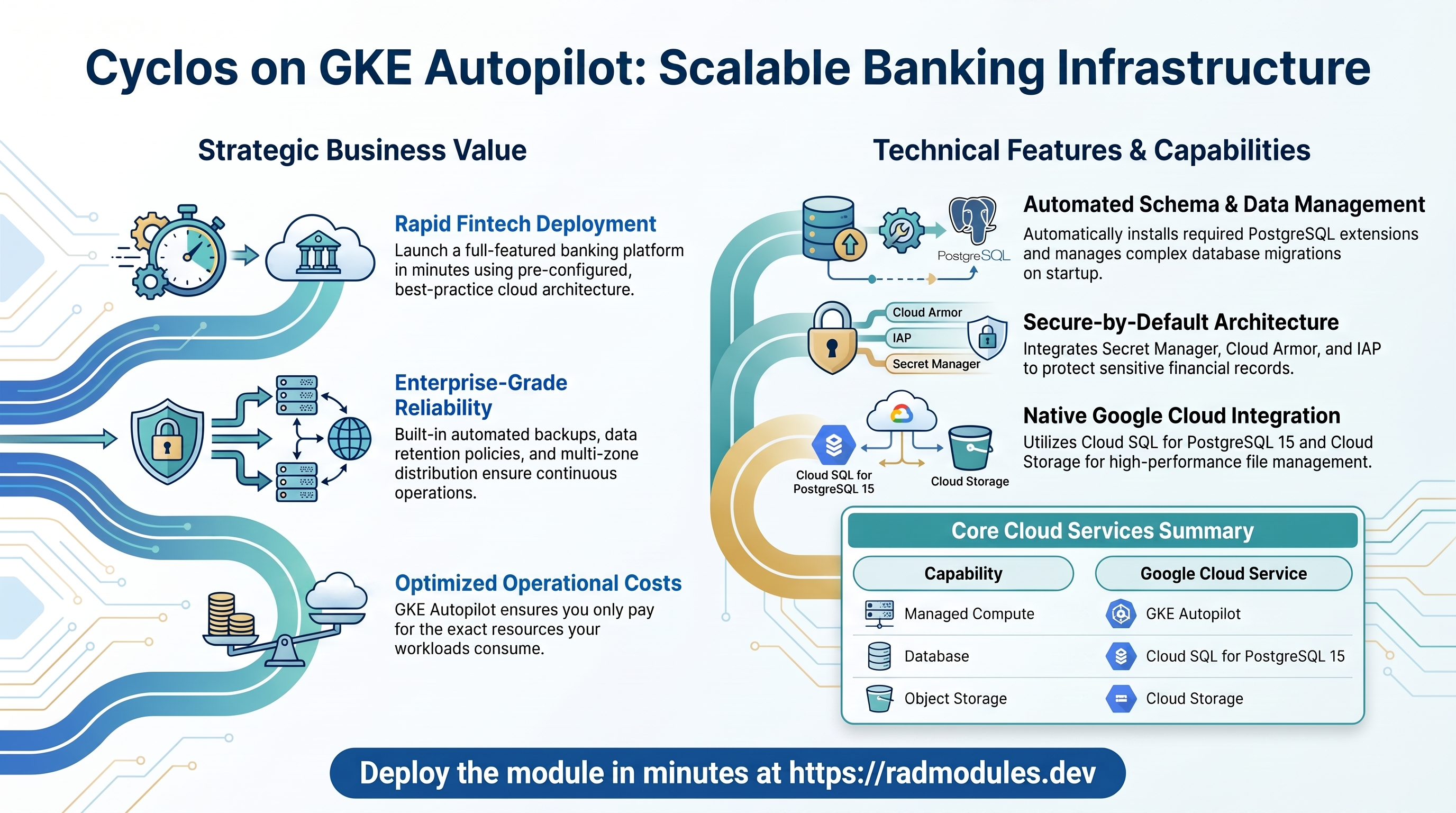
Our GKE module deploys Cyclos on Google Kubernetes Engine Autopilot, giving you:
- Horizontal Pod Autoscaling — scale Cyclos replicas properly between your defined min and max, with full Hazelcast clustering support when you're ready
- 2 vCPU / 4 GiB per pod as a recommended baseline, with the flexibility to tune resource requests to your actual workload
Full Kubernetes observability — kubectl access to pods, logs, HPA metrics, and events, giving you the operational visibility that Cloud Run doesn't expose
- The same enterprise-grade backing services — Cloud SQL for PostgreSQL 15 (with all six required extensions installed automatically), Cloud Storage for file management, and Secret Manager for credentials — all wired up out of the box
- External Cloud Load Balancing with optional custom domain and managed TLS certificate
- Autopilot bills for the CPU and memory your pods actually request, so you get the power of GKE without managing node pools.
 https://docs.radmodules.dev/docs/modules/Cyclos_GKE
Deploy it from the console at
https://radmodules.devAs always, we're here to help — drop your questions below.